By Features Writer
JOHANNESBURG — The two-month-old baby had been crying since the previous night.
Her mother, among hundreds of migrants who had been forcibly driven from their homes, was struggling to soothe the child while also caring for a toddler and another young child.
Stress and lack of food had left the mother unable to produce enough breast milk.
The baby was cold, hungry and distressed.
At this moment, Azalet Dube, a health promoter with Doctors Without Borders (MSF), realised that the tragic scenario demanded immediate action.
“Among the hundreds gathered there, I saw a woman who was struggling to soothe her two-month-old baby while also caring for a toddler and a young child who were also competing for her attention.
“She explained she couldn’t produce enough milk to breastfeed due to stress and lack of food; the baby had been crying since the previous night.
“The woman was overwhelmed and in tears. The baby was cold and hungry,” Dube says.
Dube and her colleagues immediately put aside what they were doing to help the mother and child.
“We all left what we were doing to focus on the baby.
“I took the baby and dressed her up comfortably, while the other colleague prepared formula milk,” she said.
Dube added: “After a while, the baby stopped crying and fell asleep.”
“Seeing everyone step up to support her moved me.
“It is something that will stay with me – teamwork is the key to unlocking anything,” she added.
“Such situations always leave me with a heart full of gratitude,” she said.
That encounter captures what has become central to Dube’s work of helping people through difficult moments while ensuring that no member of the team works alone.
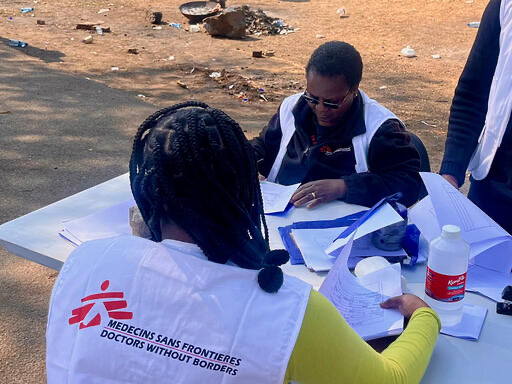
Known affectionately as “Mama Dube”, she spends her days facilitating health talks, conducting health-promotion workshops for partner organisations, sharing information with patients and communities, and listening to people who need support.
A teacher and counsellor by profession, Dube spent 10 years teaching before moving into health promotion.
Her experience in the classroom, she says, prepared her for working with patients and communities.
“My love for helping people in distress, especially children, is deep, and just knowing they are well warms my heart.
“My teaching experience prepared me for health promotion; it makes it easy to engage with patients or communities when I conduct health talks.
“I realised that the teacher in me would enable me to easily share information and make a bigger impact,” she said.
Dube’s journey with MSF began nearly eight years ago when she worked as a counsellor on a migration project supporting people excluded from accessing healthcare in central Johannesburg.
She later moved to Eshowe, KwaZulu-Natal, where she worked as a health-promotion supervisor on an HIV project.
When the Covid-19 pandemic struck in 2020, Dube supported MSF’s response in Gauteng province, going into communities to promote handwashing and mask-wearing while sharing information about the services MSF offered.
Her work during the pandemic later attracted recognition from South African President Cyril Ramaphosa, who highlighted her contribution in his weekly presidential newsletter.
Dube, however, sees that recognition as a reflection of collective effort rather than an individual achievement.
“During the COVID-19 outbreak, we worked as a team, and this is what helped us to be effective despite the massive challenges we faced.
“The President’s recognition was a testament to teamwork; it was not just my work but a contribution by each team member,” she said.
Today, Dube is once again supporting migrants displaced by anti-migrant violence in South Africa.
She is part of an MSF team working in Johannesburg to provide primary healthcare, chronic care, psychological support and first aid to people affected by the violence.
The team also provides essential items, including hygiene kits, and supports referral pathways to clinics and hospitals for patients requiring further care.
Much of that work begins with health promoters such as Dube, who help communities understand who MSF is, what services are available and how the organisation operates.
“As the HP team, we are the front runners and the face of our interventions.
“When we arrive in a community, we explain our role as MSF, who we are, what we do, the services we offer, our protocols and how we work,” she said.
“Once the community accepts us, the rest of the team follows.
“This is all teamwork because all other teams will then get into it already knowing all is set and that makes our work easier,” she adds.
Lessons from the Covid-19 response have followed Dube into the current migration intervention.
Each emergency brings different circumstances, but the principle remains the same, with health workers, counsellors, community workers and other members of the response working together if vulnerable people are to receive effective support.
Since July, the MSF team has reached more than 4,000 migrants in Gauteng province.
Along the way, Dube and her colleagues have listened to stories of loss, desperation, fear and illness while conducting health talks with individuals and groups.
Those encounters remind Dube why she chose health promotion after a decade in the classroom.
Every interaction presents a new challenge and another opportunity to make a difference, whether through sharing information, connecting someone to healthcare or simply listening.
Her most enduring lesson, however, may have come from that crowded open space in Johannesburg, where a distressed mother and her hungry baby briefly brought an entire team together.
“Mama Dube” sees teamwork as more than a principle of humanitarian work.
It is something she has seen bring comfort to a crying baby, support an overwhelmed mother and turn a desperate moment into one of relief.