By Victor Fanuel
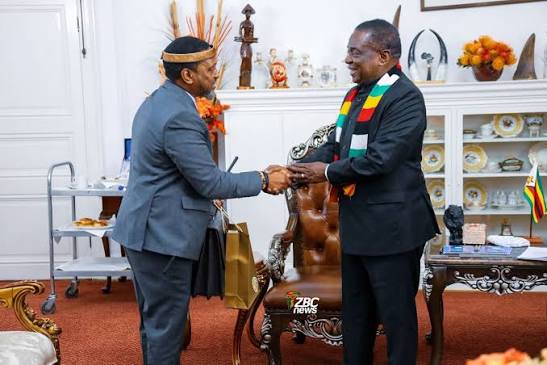
HARARE — Zulu monarch King Misuzulu kaZwelithini and King Ndamase Ndamase of the AmaMpondo in South Africa’s Eastern Cape met President Emmerson Mnangagwa in Harare on Monday, declaring their opposition to xenophobia and seeking to reassure Zimbabweans that anti-immigrant violence does not reflect the views of South Africa’s traditional leadership.
Their visit comes as South Africa grapples with renewed anti-immigrant tensions.
The unrest culminated in nationwide protests on June 30 after the “March and March” movement demanded undocumented migrants leave the country.
While many demonstrations remained peaceful, others turned violent, with attacks on foreign nationals and businesses prompting thousands of Zimbabweans and other African migrants to flee.
In a statement issued on Monday, King Misuzulu said he had travelled to Zimbabwe “not merely as the King of the Zulu nation,” but as a son of Africa who believes the continent’s greatest strength lies in its shared history, shared humanity and shared responsibility to one another.
The king confirmed he had entered Zimbabwe through the normal immigration process, presenting his passport to be stamped and declaring his nationality, the purpose of his visit and where he would be staying.
He said every sovereign nation had the same right to know who was entering its territory, for what purpose, for how long, and whether they complied with its laws.
“This is not an African principle. It’s a universal principle of international law.
“Every member state of the UN maintains borders.
“Every member state issues visas. Every member state enforces immigration laws,” he said.
He added: “Africa should never be expected to apologise for exercising rights that every sovereign nation in the world already exercises.”
The king said the continental conversation on migration had become increasingly polarised.
“On one side, there are those who wrongly conclude that every concern about illegal immigration is an expression of xenophobia.
“On the other, there are those who unfairly attribute every challenge facing their communities to foreign nationals,” he said.
King Misuzulu argued that “neither position serves Africa.”
He said violence against any innocent person, regardless of nationality, could never be justified.
At the same time, he said, sovereign states had a duty to enforce their immigration laws.
“A person who lawfully enters another country, complies with its laws, contributes positively to society and respects the institutions of that nation should always be treated with dignity,” he said.
“However, unlawful entry, document fraud, organised human trafficking and deliberate violations of immigration legislation are matters of criminal justice and public administration – not questions of race or nationality.”
King Misuzulu also appealed for regional unity, saying Southern Africa’s shared history should strengthen ties rather than fuel division.
He cited Chief Mzilikazi kaMashobane, who served under King Shaka before establishing the Ndebele nation in present-day Zimbabwe, and Soshangane kaZikode, who founded the Gaza State across parts of present-day Mozambique, Zimbabwe and Eswatini.
“These histories remind us that African identity has never been confined to colonial borders, and our shared ancestry should inspire mutual respect,” he said.
“It should never be used to justify disregarding the immigration laws of sovereign nations. Being family does not exempt us from respecting one another’s homes.”
The Zulu monarch rejected portrayals of South Africans as inherently xenophobic.
“It’s inaccurate to portray South Africans as a people who hate Africans. South Africans have for generations welcomed students, entrepreneurs, professionals, investors, refugees and visitors from across the continent,” he said.
Speaking after the meeting, Ndamase said the visit was intended to demonstrate that South Africa’s traditional leaders opposed xenophobic violence.
“We came here to Zimbabwe to show that we as traditional leaders, or royal leaders, of South Africa are against xenophobia,” Ndamase said, adding that the kings had briefed South African President Cyril Ramaphosa before travelling to Harare.
“We are here to show peace, and to show that we as black people, or African people, are one.
“So there could be many ways of fixing things between the African countries,” he said, adding that the kings wanted to engage fellow traditional leaders and heads of state across the region so that South Africa’s different tribes and nations could “speak and talk in one language and talk as one family.”
“We are not saying illegal immigrants are doing the right way of coming to South Africa illegally, but xenophobia and violence is not something which the royal leaders of South Africa want,” he said.
“Even the government of South Africa is against violence and xenophobia in South Africa.”
Ndamase said the attacks were being driven by a small group of activists and did not represent either the South African government or the country’s traditional leadership.
“There is March and March that is happening in South Africa. It is just a few people… It does not come from the government, it does not come from the royal leaders,” he said.
“So we want to show Africa that South Africa is still a country that everybody is invited to come to, and everybody can stay in South Africa peacefully.”
South African President Cyril Ramaphosa has repeatedly condemned vigilante action against foreign nationals, warning that immigration enforcement is the responsibility of the state and not private citizens.
Police have arrested hundreds of people during recent demonstrations, while authorities have stepped up border enforcement amid growing political pressure over illegal immigration.
Reports suggest that the anti-immigrant sentiment has been fuelled by high unemployment, slow economic growth and claims that undocumented migrants compete for jobs and public services.
Researchers, however, have found little evidence that migrants reduce employment opportunities for South Africans, while warning that the exodus of foreign workers could disrupt sectors including agriculture, construction, transport and retail.
Ndamase, who chairs the Kings Forum of South Africa, wrote to Mnangagwa on July 3 requesting the audience, describing the Zimbabwean leader as a committed Pan-Africanist.
The two kings had separately met Ramaphosa on June 27 and 28 to discuss the government’s response to the anti-immigrant tensions before deciding to embark on regional engagements.