By Victor Fanuel
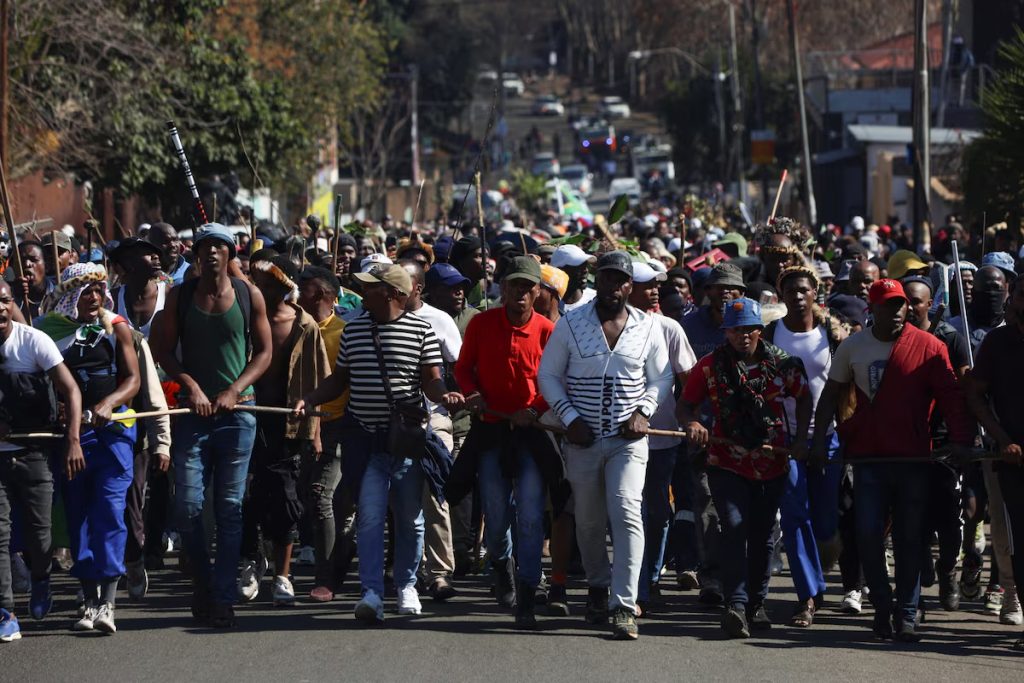
DURBAN, South Africa — Anti-immigrant protesters marched across South Africa on Tuesday to enforce a self-imposed deadline demanding that undocumented migrants leave the country, with demonstrations in several areas descending into violence, looting and clashes with police.
Thousands of African foreign nationals had already fled the country ahead of the marches, fearing attacks after months of escalating anti-migrant unrest that has drawn international condemnation.
Shops remained closed in several communities while many foreign workers stayed away from work amid fears of further violence.
At least four people have been killed since the unrest intensified, while thousands of migrants have been displaced from their homes and seen their businesses and property vandalised.
The protests were organised by the anti-immigration group March and March, whose leader, Jacinta Ngobese, vowed that the campaign would continue until the group’s demands were met.
“For the next six months, we are asking for our national resources to be used to take the illegal immigrants out of this country.
“From building to building – they must go,” Ngobese told supporters during a march in the port city of Durban.
Among those participating in the demonstration was 31-year-old Silindile Xaba, who blamed undocumented migrants for South Africa’s unemployment crisis.
“People are not working, the jobs are being taken by illegal foreigners. It’s not fair,” she said.
The protests have intensified political tensions ahead of South Africa’s local government elections expected in November, with critics accusing some politicians of exploiting anti-immigrant sentiment to attract votes.
Although many demonstrations remained peaceful, violence erupted in several areas.
In Tembisa, east of Johannesburg, groups of rioters hurled stones at police officers and suspected migrants, while sporadic gunfire was reported near the township’s central business district.
Police also deployed tactical response units in Benoni after about 500 protesters reportedly threatened violence, while arrests were made for looting in several locations.
National broadcaster SABC reported that foreign-owned shacks were looted in Soweto, while police fired rubber bullets to disperse protesters in Pietermaritzburg.
South African police had not immediately released a comprehensive account of the day’s incidents.
The unrest follows a pattern of recurring xenophobic violence that has periodically erupted across South Africa since 2008, often targeting foreign nationals regardless of their immigration status.
Ngobese distanced her organisation from attacks carried out away from organised marches, saying spontaneous violence by community members was beyond the group’s control.
“Unfortunately, we can’t be in every single community telling them … how to behave,” she told Reuters in an interview two weeks before Tuesday’s protests.
Witnesses in Durban and Johannesburg said some landlords had illegally evicted foreign tenants ahead of the demonstrations to avoid their properties being targeted.
In Durban, about 100 Congolese nationals were reportedly sleeping on the streets after being forced from their accommodation.
The marches attracted thousands of predominantly unemployed South Africans who accuse migrants of taking jobs, increasing crime and placing pressure on public services.
Thousands of police officers were deployed nationwide, while the South African military remained on standby.
The latest violence has further damaged South Africa’s reputation as a champion of human rights in the post-apartheid era and strained relations with several African countries whose citizens have been targeted.
Social scientists, however, dispute claims that migrants are responsible for rising unemployment and crime, saying available evidence does not support those assertions.
Despite remaining Africa’s largest economy, South Africa continues to struggle with deep inequality and an unemployment rate affecting roughly one-third of the population, factors widely seen as fuelling anti-immigrant sentiment.
According to Statistics South Africa (StatsSA), the country hosts about three million immigrants, representing approximately four percent of the total population.
Deputy National Commissioner for Policing Tebello Mosikili said authorities had opened 103 criminal cases against anti-foreigner vigilante groups since March.
President Cyril Ramaphosa acknowledged growing public concern over illegal immigration but condemned violence and intimidation.
“South Africans’ deep concerns about illegal immigration are real and they deserve to be heard.
“But the right to protest does not allow people to threaten or intimidate others, or to engage in acts of vandalism or violence,” Ramaphosa said in a statement on Monday.
South African authorities have argued that the country is confronting immigration pressures similar to those experienced in many Western nations, where migration has become an increasingly polarising political issue.