By Victor Fanuel
HARARE — People’s Unity Party (PUP) leader Herbert Chamuka has made a dramatic U-turn on Zimbabwe’s controversial constitutional reforms, abandoning his earlier support for Constitutional Amendment Bill No. 3 (CAB3), which has since become Constitutional Amendment Act No. 3 (CAA3).
Chamuka backed the amendment when it was still before Parliament as CAB3, but now argues that CAA3 should never have taken effect in its present form.
His reversal puts him at odds with his earlier position as he now argues that the changes have weakened the relationship between the presidency and citizens and created room for Zanu PF-aligned officials to use the altered constitutional framework against citizens, vendors and informal traders struggling under a deteriorating economy.
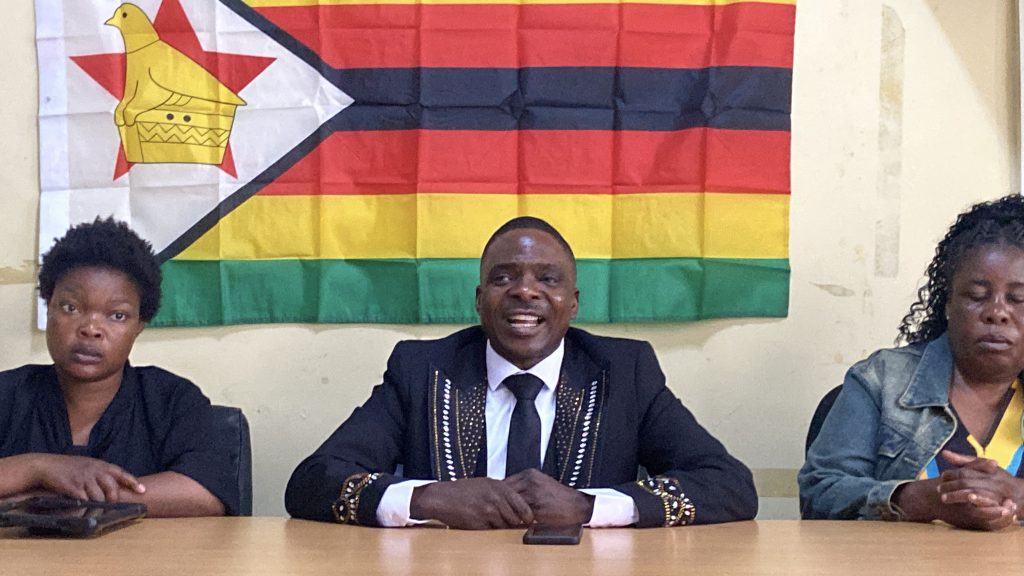
Addressing the media on Tuesday, Chamuka said CAA3 should only take effect after the next election in 2028, even as he separately argues that Zimbabwe does not need another election but an inclusive government bringing together the ruling party, opposition, churches, civil society and technocrats.
“As the leader of PUP who endorsed CAB3 before it was signed into law as CAA3, I took time to analyse the new law. While I believe it has some positive aspects, there are also serious anomalies that need to be addressed.
“My position is that CAA3 should not have come into effect immediately. It should have been implemented after the next election so that the people could first exercise their right to directly elect a president under the existing system.
“The biggest beneficiary of this arrangement is not specifically President Emmerson Mnangagwa, but the presidency itself and any future leader who succeeds him,” he said.
CAA3 replaced direct presidential elections with a system under which the president is elected by a joint sitting of Parliament, while also extending the presidential, parliamentary and local authority terms from five to seven years.
Chamuka now argues that the change has created a political environment in which citizens have less direct leverage over the presidency and government officials can act against them without the same electoral pressure.
“Under CAA3, the president is no longer elected directly by the people. The president is elected by Parliament.
“That fundamentally changes the direct relationship between the highest office in the land and the citizens because the president no longer has to seek a direct mandate from the electorate.
“We are now seeing politicians and government officials taking advantage of this changed political environment to victimise ordinary people, particularly vendors and informal traders,” he said.
His comments come as government has intensified its campaign against informal traders in Harare, with Local Government and Public Works Minister Daniel Garwe personally overseeing parts of the operation alongside council officials.
Garwe issued a September 9 deadline for vendors operating from undesignated areas to leave before a “comprehensive, zero-tolerance” clean-up operation.
The City of Harare later confirmed that Garwe and Mayor Jacob Mafume had toured the CBD to monitor Operation Chenesa Harare.
Newly appointed permanent secretary Tafadzwa Muguti has since joined Garwe in enforcing the government’s new vending regime.
Muguti was appointed to the ministry on September 11, replacing John Basera, and days later announced that vending in CBDs across the country would be restricted to between 6am and 6pm.
Government says the operation is intended to restore order, cleanliness, safety and accessibility, while insisting that vendors should move to designated trading areas rather than abandon their livelihoods.
Chamuka, however, sees the crackdown as evidence of what he describes as the dangers of reduced direct electoral accountability.
“The demolitions, the crackdown on vendors and the growing disregard for the concerns of ordinary citizens are symptoms of a system in which the direct electoral relationship between the presidency and the people has been weakened.
“If CAA3 is applied immediately, powerful people within government and Zanu PF can take advantage of the reduced direct electoral accountability to abuse their offices and authority against ordinary citizens, as we are witnessing with vendors in Harare’s CBD,” he said.
Chamuka’s argument comes with an obvious political contradiction in that while he is demanding that CAA3 be delayed until after the 2028 election, he says PUP no longer believes Zimbabwe needs elections.
Instead, Chamuka said his party has adopted an Inclusive Government Agenda (INGA) and recently petitioned Mnangagwa to form an administration bringing together opposition parties, civil society, technocrats and churches.
“We have sent a letter to the Munhumutapa offices, to President Emmerson Mnangagwa’s office, and we understand right now he is at the United Nations with other world leaders.
“We have the confidence that once he is back he will take notice of our letter and invite us to a round-table discussion on the matter of an inclusive government that will consist of opposition parties, civil society and technocrats to promote national cohesion on the national development and unity agenda,” he said.
Chamuka said PUP would take the INGA campaign nationwide, reaching all 10 provinces and lobbying community leaders, churches and other stakeholders to support its call for an inclusive government.
His new position therefore places him in an unusual political space.
Chamuka wants direct presidential elections restored before CAA3 takes effect, while simultaneously arguing that Zimbabwe should move away from elections towards an inclusive government.
The shift also comes after Chamuka previously told Zimbabweans to accept CAA3 while it was still CAB3, saying parliamentary voting would remove opportunities for presidential election rigging and urging citizens to shun protests against the amendment.
Chamuka said the same law risks weakening accountability and enabling those in power to act against ordinary citizens.