By Staff Reporter
HARARE — The United States has announced it will begin winding down its health assistance to Zimbabwe after President Emmerson Mnangagwa withdrew from negotiations over a proposed bilateral health agreement.
The decision places an estimated 1.2 million people receiving HIV treatment at immediate risk unless the Zimbabwean government intervenes to close the funding gap.
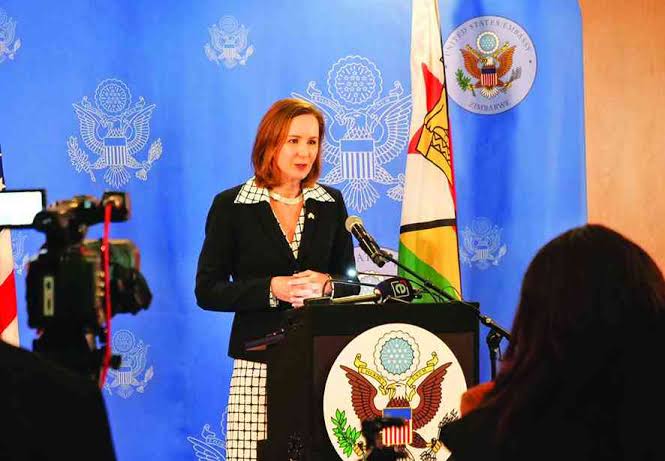
In a statement issued on Tuesday, US Ambassador to Zimbabwe Pamela Tremont confirmed the collapse of the talks and stated that the consequences would be both swift and far-reaching
“We will now turn to the difficult and regrettable task of winding down our health assistance in Zimbabwe,” she said.
Tremont, who met foreign affairs minister Amon Murwira last week, said the Zimbabwean government had “assured us it is prepared to sustain the fight against HIV/AIDS”.
“We wish them well,” she added, in remarks that appeared to shift responsibility squarely onto Harare.
The proposed memorandum of understanding (MoU) was intended to provide the framework for continued US health support under Washington’s America First Global Health Strategy (AFGHS).
However, the Zimbabwean government deemed the agreement unacceptable on several grounds.
A letter dated December 23, 2025, written by Foreign Affairs Secretary Albert Chimbindi, instructed the permanent secretaries for finance and health to immediately halt all discussions, acting on direct orders from the president.
“The president has directed that Zimbabwe must discontinue any negotiation with the USA on the clearly lopsided MoU that blatantly compromises and undermines the sovereignty and independence of Zimbabwe as a country,” the letter stated.
Diplomatic sources said Mnangagwa objected in particular to provisions granting the United States access to Zimbabwe’s national health data, which officials characterised as an intelligence overreach, as well as clauses allegedly linking the agreement to access to Zimbabwe’s critical mineral resources.
The US embassy strongly rejected that characterisation, stating that the proposed MoU would have delivered $367 million over five years to support HIV/AIDS treatment and prevention, tuberculosis, malaria, maternal and child health, and disease outbreak preparedness.
Washington described the package as the single largest prospective health investment in Zimbabwe by any international partner.
It said the agreement was structured around a co-funding model aimed at gradually increasing Zimbabwe’s domestic health spending while reducing long-term reliance on external aid.
US officials also cited broader African participation in similar arrangements.
16 African countries have signed comparable agreements, unlocking a combined $18.3 billion in health financing, comprising $11.2 billion from the United States and $7.1 billion in co-investment from recipient governments.
“The United States has a responsibility to American taxpayers to invest their resources where mutual accountability, transparency, and shared commitment are assured,” Tremont said.
Since 2006, the US has provided more than $1.9 billion in health assistance to Zimbabwe.
American-funded programmes are widely credited with helping the country achieve the UNAIDS 95-95-95 targets, the global benchmark for HIV diagnosis, treatment and viral suppression.
The future of the estimated 1.2 million Zimbabweans currently receiving HIV treatment through US-supported programmes remains uncertain as the wind-down begins.
Mnangagwa’s government has not publicly outlined how it intends to replace the funding or provided a timeline for transitioning patients to alternative sources of support.
Source — ZimLive