By Staff Reporter
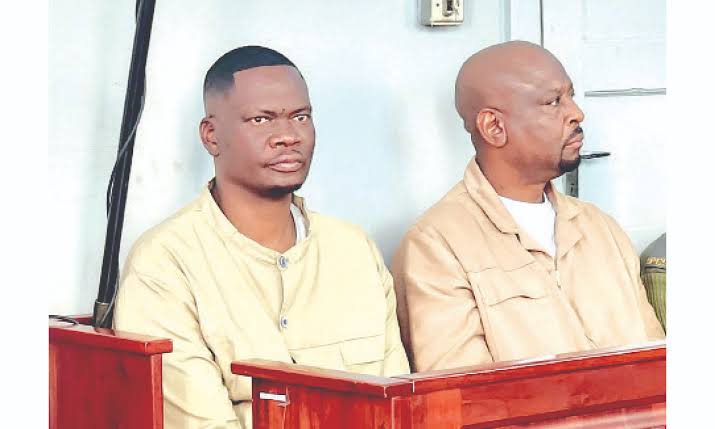
HARARE — The High Court has rejected applications by Moses Mpofu and Mike Chimombe for leave to appeal both their conviction and sentence, with Justice Pisirayi Kwenda ruling that their intended appeals were “frivolous, vexatious and an abuse of court process.”
Mpofu and Chimombe were jointly convicted in December 2025 for defrauding millions under the Presidential Goat Pass-On Scheme and were handed lengthy prison terms, partly suspended on condition of restitution.
In Monday’s ruling, Justice Kwenda said the applicants failed to show reasonable prospects of success, the threshold required for leave to appeal.
“In order to succeed, it is not enough for the applicant to make out an arguable case… there must be substance in the argument,” the judge said, citing S v McGown.
The court found that the fraud was carried out through a fictitious entity, Blackdeck Livestock and Poultry Farming, falsely presented as a registered company eligible to supply goats under the government programme.
Justice Kwenda noted that the entity “did not exist as a company incorporated in terms of the laws of Zimbabwe with the legal capacity to act,” yet was deliberately portrayed as legitimate using documents from Blackdeck (Pvt) Ltd.
To avoid automatic disqualification, the accused submitted counterfeit ZIMRA tax clearance and NSSA compliance certificates, which forensic evidence showed had been altered from certificates belonging to Skywalk (Pvt) Ltd.
“As a result of the misrepresentation, the fraudulent bid… was accepted by the Ministry and treated as valid,” Kwenda said.
The ministry of agriculture ultimately paid about ZWL$1.6 billion (US$7.7 million) into Blackdeck’s bank account but received goats worth only about US$331,000, with the remainder rapidly dispersed to other companies and traded on the foreign-currency black market.
In dismissing Mpofu’s application, the judge said evidence showed he was central to the fraud.
“Mpofu conceived the idea to submit the bid.
He was aware that Blackdeck Livestock & Poultry Farming was not a registered company and thus lacked the capacity to act,” Kwenda said.
The judge highlighted that Mpofu admitted knowing tax clearance certificates were mandatory, signed the contract on behalf of the fictitious entity, supplied Blackdeck’s bank account details, and represented the company throughout the scheme.
“In terms of section 277 of the Criminal Law Code, a director is personally criminally liable for any offence for which his company is criminally liable… In this case, it is common cause that Mpofu admitted he took part.”
Kwenda called it “frivolous” for Mpofu’s lawyers to argue that Blackdeck Livestock and Poultry Farming was a lawful corporate entity when no legal steps had ever been taken to register it.
In unusually sharp language, the judge criticised aspects of the defence, saying insisting that no fraud occurred while admitting the use of counterfeit documents “shows disdain for court processes.”
Chimombe, who denied a formal role in Blackdeck, was convicted as a co-perpetrator under section 196A of the Criminal Law Code.
“Proof of association with the intention to commit a crime, or knowledge that it would be committed, suffices,” Kwenda said, noting that Chimombe repeatedly appeared with Mpofu at ministry meetings, played a leading role in engagements, and controlled Millytake Enterprises, which received ZWL$200 million from the scheme.
“The state led evidence to prove that Chimombe appeared at the ministry together with the Mpofu on various occasions associating himself with the fictitious company,” the judge said.
Kwenda dismissed Chimombe’s claim that the court had “gone on a frolic of its own,” calling it a deliberate mischaracterisation of the charges.
Mpofu was sentenced to 22 years’ imprisonment, partly suspended on condition of restitution of US$2.06 million, while Chimombe received 17 years, partly suspended on condition he pays US$964,064.
The judge said the seriousness of the offence, the scale of public funds involved, and the deliberate deception of the state justified the heavy sentences.
Both applications for leave to appeal were dismissed in full.