By Staff Reporter
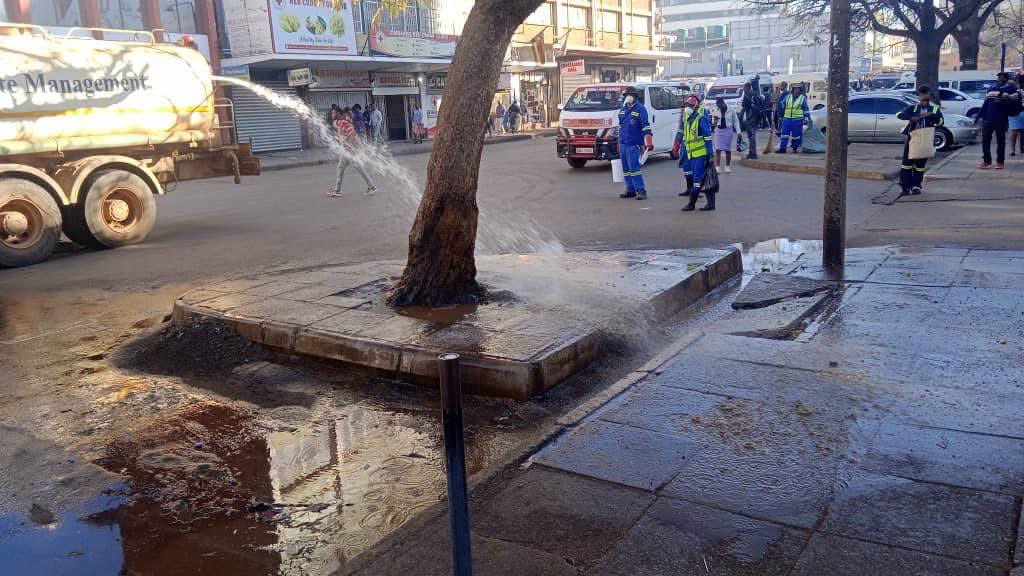
HARARE — Geo Pomona Waste Management (Pvt) Ltd and the City of Harare have rolled out weekly deep-cleaning and disinfection of illegal public toilet hotspots in the central business district, marking a joint effort to tackle one of the capital’s most persistent public health and sanitation challenges.
The joint operation, now scheduled for every Sunday, targets areas that have become notorious for public urination and defecation, with authorities seeking to improve public health, restore cleanliness and curb environmental hazards in the city centre.
On Sunday, teams disinfected and sanitised Cleveland House along Cameroon Street, the CBD footbridge, Rezende Open Space at the corner of Julius Nyerere Way and Robert Mugabe Way, the corner of Simon Vengai Muzenda Street and Robert Mugabe Way, Sanitary Lane between Chinhoyi Street, Mbuya Nehanda Street and Jason Moyo Avenue, the corner of Harare Street and Samora Machel Avenue, the NetOne Building and the Fidelity Building along Nelson Mandela Avenue.
The exercise forms part of a broader partnership between the local authority and Geo Pomona aimed at improving urban sanitation standards in the capital.
In a statement on Monday, Geo Pomona said the weekly CBD clean-up forms part of a sustained campaign to restore hygiene standards in the capital while supporting the City of Harare’s efforts to tackle illegal public toilets.
“We are proud to continue our Sunday CBD deep cleaning drive alongside the City of Harare.
“Under the visionary leadership of our Executive Chairman & CEO, Dr Dilesh Nguwaya, Geo Pomona remains dedicated to elevating urban sanitation standards.
“We are here to protect our tomorrow,” read the statement.
Geo Pomona executive chairman Dr Dilesh Nguwaya has previously argued that sustainable waste management requires the collective participation of government, the private sector and residents, saying Zimbabwe must adopt world-class waste management practices while fostering greater public responsibility for keeping cities clean.
However, while the weekly clean-up programme has been welcomed as a practical response to deteriorating sanitary conditions in the CBD, it also raises questions about the city’s limited public toilet infrastructure.
Residents and urban planning experts have long argued that Harare needs to invest in more accessible and properly maintained public toilets to address the root causes of illegal public urination and defecation, rather than relying primarily on recurring clean-up and disinfection exercises.
The Sunday programme is expected to continue every week as the City of Harare and Geo Pomona seek to improve hygiene standards and restore the image of the capital’s central business district.