By Victor Fanuel
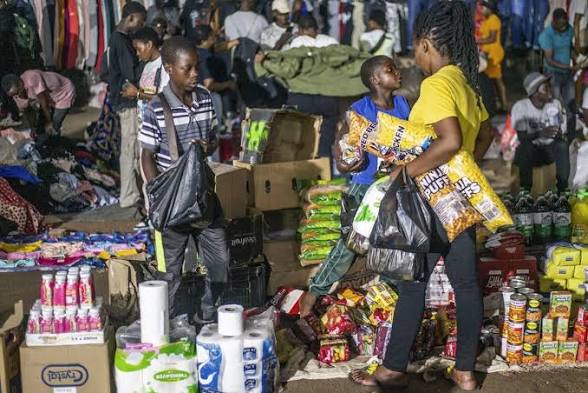
HARARE — Local Government and Public Works Minister Daniel Garwe has ordered a fresh crackdown on illegal vending in Harare, declaring that the deterioration of urban order is no longer acceptable.
However, the latest enforcement drive risks repeating a cycle of evictions and returns that has persisted under successive governments.
Garwe’s order follows a seven-day ultimatum issued to vendors operating from unauthorised sites, with the deadline set for Wednesday, September 9, 2026.
Government has warned that the crackdown will target illegal vending structures, stalls and trading sites in Harare’s central business district.
“The situation is no longer acceptable and it is no longer business as usual.
“His Excellency the President of the Republic of Zimbabwe, Dr Emmerson Mnangagwa, and this Government remain deeply concerned by the deterioration of urban order and the gradual erosion of the standards that should define our capital city,” he said.
Garwe said the operation was not intended to victimise vendors or formal traders.
“Let me state at the outset that this is not a declaration of war against vendors and any formal traders.
“This is not a declaration of victimisation of anybody,” he said.
However, the government’s acknowledgement that thousands of Zimbabweans depend on vending highlights the economic challenge facing the crackdown.
Authorities are removing informal traders from unauthorised sites without providing sufficient formal employment opportunities or viable alternatives for those who rely on vending for their livelihoods.
“We recognise that vending provides livelihoods to thousands of Zimbabweans.
“We also recognise the economic circumstances that have driven many people into informal trading.
“We also recognise the entrepreneurial spirit of our residents and the important role that small and informal businesses play in sustaining families and communities,” Garwe said.
Zimbabwe’s history of vendor evictions shows that removing traders from the streets has repeatedly failed to eliminate the informal trading that brings them back.
In May 2005, government under Operation Murambatsvina destroyed informal businesses and market stalls across the country.
Human rights groups documented the destruction of flea-market stalls and business structures, including stalls belonging to licensed informal traders.
The operation was justified by officials as an effort to restore order and sanity, but it also displaced people who depended on informal trading for their livelihoods.
In 2015, government again moved against Harare vendors, with research documenting threats of eviction and resistance from traders who said they had no alternative means of livelihood.
This pattern continued in 2017 and 2020, when authorities again pursued the removal of informal traders and the demolition of illegal stalls.
Repeated returns by vendors have highlighted the difficulty of resolving the problem through enforcement alone.
Civic society groups have argued that vendors operating in Harare’s informal economy often return because designated sites are poorly located, lack adequate facilities or do not provide access to the customers they need.
At the same time, government has not demonstrated that it has created enough formal employment opportunities to absorb those being pushed out of the informal economy.
The growth of informal household enterprises in Harare has also been linked to deepening macroeconomic challenges and limited opportunities in the formal economy.
Government continues to encourage traders to move into formal trading spaces, but the formal labour market has not expanded sufficiently to provide alternative livelihoods for many people who have turned to vending.
Harare Mayor Jacob Mafume said the operation would begin at the corner of E D Mnangagwa Road, formerly Enterprise Road, and Samora Machel Avenue, before moving into populated areas.
“We are going to increase the complement of municipal police that are going to be in the streets tomorrow to close to 200 or 300 police or more should the situation require,” he said.
Mafume said the operation would initially be persuasive and peaceful, with authorities seeking to convince vendors operating from undesignated areas to move to approved trading sites.
“But as you have heard, this is largely a persuasive operation, a peaceful operation.
“We are simply moving phase to phase and illustrating the need for vendors to operate in an orderly manner and at designated places,” he said.
The mayor said the operation was necessary to free space for traffic and pedestrians.
“We need to free up space for traffic, for pedestrians, for vehicles and the city to be able to breathe in terms of navigability and also the ease of doing business,” he said.
Mafume defended council’s designated vending facilities, saying the Mbare market had modern amenities but traders continued to prefer operating outside.
“We’ve built one of the best markets in Africa, if not the world, in Biri.
“Surprisingly, the place has got the best toilets, the best basement, the best lighting, quite aerated.
“But vendors prefer to sell outside,” he said.
Garwe said the operation was consistent with Zimbabwe’s aspiration to become an upper-middle-income society by 2030 and the objectives of National Development Strategy.
The latest crackdown therefore places renewed focus on how government intends to balance the enforcement of municipal regulations with the livelihoods of thousands of people operating in the informal economy.