By Marshall Bwanya
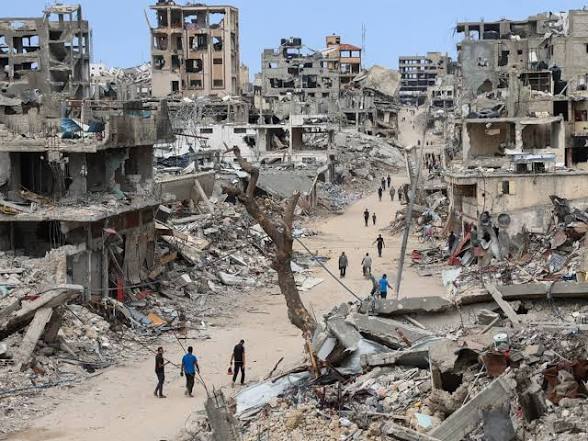
LONDON — More than 70,000 Palestinians are dead, at least 20,000 of them children, millions have been displaced and Gaza has been reduced to a landscape of shattered homes and broken families.
For British Prime Minister Andy Burnham, the devastation has become impossible to reconcile with years of Western declarations in support of a two-state solution.
“The suffering of the Palestinian people is a scar on the conscience of the world.
“Innocent Palestinians, including children, continue to be killed in Gaza.
“And there is still a humanitarian crisis, with far too little aid getting in,” Burnham said in a social media statement on Tuesday.
Burnham’s intervention came as Britain announced a major policy shift towards Israel, including a ban on trade in goods from Israeli settlements in the occupied West Bank and sanctions against individuals and companies involved in settlement activity.
Britain also formally changed its position to recognise Israel’s occupation of Palestinian territory as unlawful.
The measures mark one of the sharpest breaks yet by a major Western ally with the government of Israeli Prime Minister Benjamin Netanyahu.
But behind the diplomatic language lies a human catastrophe that rights groups, UN investigators and humanitarian organisations have documented for years.
Amnesty International has accused Israel of committing genocide in Gaza, citing mass killings, starvation, forced displacement and the destruction of homes and other civilian infrastructure.
In September 2025, the UN Independent International Commission of Inquiry concluded that Israel had committed genocide against Palestinians in Gaza.
It found that Israeli authorities and forces had committed acts including killing, causing serious bodily or mental harm, deliberately inflicting conditions of life calculated to bring about the physical destruction of Palestinians and imposing measures intended to prevent births.
Human Rights Watch has separately documented what it described as extermination and acts of genocide, including the deliberate deprivation of adequate access to water for Palestinian civilians.
The findings have added weight to growing international pressure on Israel, although Israel rejects allegations of genocide and has repeatedly defended its military campaign as a response to the October 7, 2023 attacks by Hamas.
Burnham himself made clear that his condemnation of Israel’s conduct did not amount to support for Hamas.
“I have condemned the monstrous terrorist attack on Israel on 7 October 2023 in the strongest possible terms – and continue to condemn Hamas.
“However, it does not justify the Israeli government’s actions in Gaza or the West Bank,” he said.
That distinction was central to Burnham’s statement.
He said Britain had spent years supporting a two-state solution while failing to take sufficient action as Israeli settlement expansion continued to eat into territory Palestinians claim for a future state.
“We have called for years for a two-state solution in the Middle East, but we must recognise that those words are meaningless unless we back them up with action.
“For too long, we have been hesitant to act, fearful of being accused of being anti-Israel,” Burnham said.
The consequences of that hesitation, he argued, can now be seen in Gaza and the occupied West Bank.
Burnham said more Israeli settlements had been approved during the current Israeli government’s four years in power than in the previous two decades, while citing more than 1,500 incidents of settler violence reported by the UN this year.
He also singled out the proposed E1 settlement project, which he said would carve through the West Bank and destroy any realistic prospect of a contiguous Palestinian state.
“This would cut a swathe through the heart of the West Bank – snuffing out the hope of realising a two-state solution
“It cannot be allowed to happen,” Burnham said.
The International Court of Justice ruled in a 2024 advisory opinion that Israel’s continued presence in the occupied Palestinian territory is unlawful and said Israel must end its presence there as rapidly as possible and cease new settlement activity.
That ruling is separate from the genocide proceedings brought by South Africa against Israel at the ICJ.
The court has issued provisional measures in that case, but has not yet delivered a final judgment determining whether genocide has occurred.
For Palestinians, however, the legal distinctions offer little comfort amid the destruction.
Amnesty has described Gaza’s population as subjected to mass starvation, killings, displacement and the destruction of civilian infrastructure.
Burnham said millions had been forced from their homes.
“Families and communities have been torn apart.
“Millions displaced.
“And the population of Gaza is now penned into just one third of the territory,” he said.
Burnham added: “The scale of destruction is hard to comprehend.”
The British leader also acknowledged that his own country’s response had been inadequate.
“Before I became Prime Minister, I said our country’s response had been too slow and simply not good enough.
“That’s why I committed to changing the government’s approach,” he said.
Britain is now attempting to turn that change into policy.
The government says the settlement measures are directed at the Israeli government’s policies rather than ordinary Israelis, while a new humanitarian aid package has also been announced for Gaza.
Burnham was equally emphatic that Britain’s Jewish population should not be held responsible for Israel’s actions.
“The Israeli people are not responsible for the actions of their government.
“And nor is the Jewish community in the UK.
“Blaming British Jews for the actions of Benjamin Netanyahu’s government is wrong, plain and simple. And it is antisemitism, plain and simple,” he said.
The distinction is particularly important as the Gaza conflict has fuelled fierce political divisions and protests across Britain and other Western countries.
Burnham said he had met representatives of Britain’s Jewish community and understood their fears, promising that his government would continue fighting antisemitism.
But he also said Britain could not use the fear of accusations of antisemitism as a reason for ignoring Palestinian suffering.
Israel has already reacted angrily to Britain’s measures. Israeli authorities have ordered the closure of Britain’s consulate in East Jerusalem and imposed other restrictions on British officials in response to the sanctions.
For Burnham, however, the diplomatic consequences are secondary to what he says is at stake.
“I will not stand by as the horrific suffering continues to grow and the prospect of a two-state solution – the best hope for peace and stability in the region – comes under attack
“The measures we are announcing today are about protecting the only solution that could see the Israeli and Palestinian people living side by side in peace and security,” he said.
For a population that has watched homes disappear, families fracture and children die, the words “two-state solution” may sound remote.
Burnham knows that.
His argument is that if Britain and other Western powers continue talking about Palestinian statehood while allowing the territorial basis for that state to disappear, the phrase becomes little more than diplomatic theatre.
“We are taking these steps because it is the right thing to do.
“The government I lead will keep working with our partners around the world to keep that hope alive,” Burnham said.