
By Victor Fanuel
HARARE — A preliminary investigation into the helicopter crash that killed businessman Wicknell Chivayo, his wife and three others has revealed chilling details of the aircraft’s final minutes before it smashed into a farm near Marondera.
Investigators found no evidence of an in-flight explosion or that the Bell 430 helicopter broke apart before hitting the ground, although the report stops short of establishing what caused the September 30 disaster.
The Ministry of Transport and Infrastructural Development’s Air Accidents and Incidents Investigation Department says the aircraft remained intact until impact, when it disintegrated under the force of the collision.
“There is no evidence of an in-flight breakup or pre-impact explosion,” the report states.
The findings offer the clearest account yet of what happened aboard the helicopter, registration Z-PED, as it encountered deteriorating weather conditions during a flight from Gandami Village in Chikomba District.
Flying in formation with a Bell 407, registration Z-OSM, the helicopter encountered low cloud about 10 minutes after taking off at 4.20PM.
Both aircraft were operating under visual flight rules.
“The flight was uneventful until approximately ten minutes after departure, when a low-level cloud layer was reported approaching from the east,” the report says.
The accompanying Bell 407 turned west to avoid the cloud, while Chivayo’s helicopter continued north-east after reporting that the route in that direction was clear.
After proceeding to its destination, the Bell 407 lost contact with Z-PED, whose last radio communication indicated that it had entered another layer of cloud and had not yet emerged.
“The last radio transmission from Z-PED indicated that the aircraft had entered a further layer of cloud and had not yet emerged from it,” the report says.
Witnesses at Kudenga Farm, about 22km south-west of Marondera, said they could hear the helicopter overhead but were unable to see it because of poor visibility.
Its sound continued for approximately 10 minutes before witnesses in different parts of the farm heard a loud impact, followed by silence.
Police were alerted at 5PM and arrived 15 minutes later, finding the helicopter wreckage scattered across a field with no survivors.
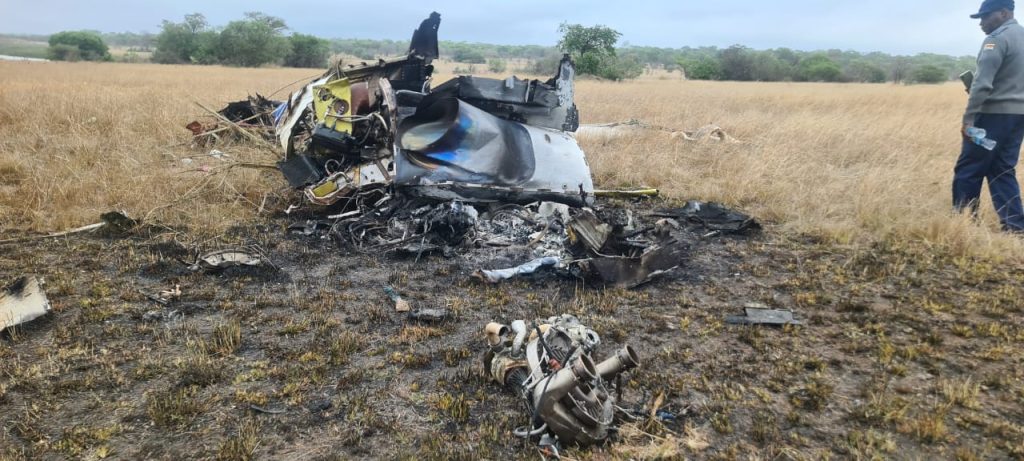
Part of the aircraft was still burning, although drizzle kept the fire confined to the immediate crash area.
Witnesses described heavy fog, drizzle and extremely poor visibility at the time of the accident.
The Meteorological Services Department had issued a severe weather advisory covering September 29 to October 1, warning of widespread thunderstorms, lightning and strong wind gusts.
Weather observations around Harare recorded broken to overcast cloud, with exceptionally low ceilings of between 1,500 and 2,000 feet.
Marondera’s 5PM observation showed overcast conditions at 2,000 feet, accompanied by light drizzle.
The pilot had obtained weather information from air traffic control at Robert Gabriel Mugabe International Airport.
Investigators say the distribution of wreckage supports their finding that the helicopter remained intact until ground impact.
Debris was scattered across an area measuring approximately 170 metres long and 75 metres wide.
The tail rotor assemblies were found 10 metres from the first point of ground contact, while the tail boom lay 84.7 metres away.
Further wreckage included the main rotor hub and gearbox, located 140 metres from the initial impact point, while the fuselage and both engines were found 145 metres away.
Investigators said the crash was not survivable because of the enormous deceleration forces and the severity of the fire that followed.
“All occupants were ejected from the aircraft just after the initial point of impact when the fuselage disintegrated,” it says.
Those killed were Chivayo, his wife Lucy, security officer Senelisiwe Magagula and pilots Calvin Soda and Courage Mutavira.
The helicopter, operated by Sky Helicopters Company (Pvt) Ltd on a private flight, was completely destroyed.
Pilot-in-command Soda, 44, held a commercial helicopter licence and had accumulated 2,756 flying hours, including 614 hours on the Bell 430.
He had a valid medical certificate and no previous recorded occurrences.
Investigators found no evidence that physiological factors or incapacitation had affected the flight crew’s performance.
The helicopter was built in 2004 and underwent its last inspection on August 25, 2026, some 46 flying hours before the crash.
It was fitted with a ground proximity warning system, dual auto flight system, weather radar and GPS.
Investigators have also found no deficiencies or discrepancies in the organisation’s management of the aircraft and its operations.
However, the cockpit voice recorder was not recovered from the wreckage and is presumed to have been destroyed.
The investigation team plans to visit the Approved Maintenance Organisation to examine the helicopter’s complete maintenance records, having so far obtained only copies of the latest documents.
Meanwhile, the wreckage has been moved to a secure facility, while investigators have interviewed the crew of the accompanying Bell 407, eyewitnesses and first responders.
The ministry stressed that the preliminary report is a factual account and does not establish the probable cause of the disaster.
“Further analysis and investigation are necessary to determine the probable cause(s) and contributing factors,” it says.
It added that the investigation was not intended to apportion blame or liability and that the report was not admissible in a court of law.
A final report, expected after the investigation is completed, will include safety recommendations.