By Marshall Bwanya
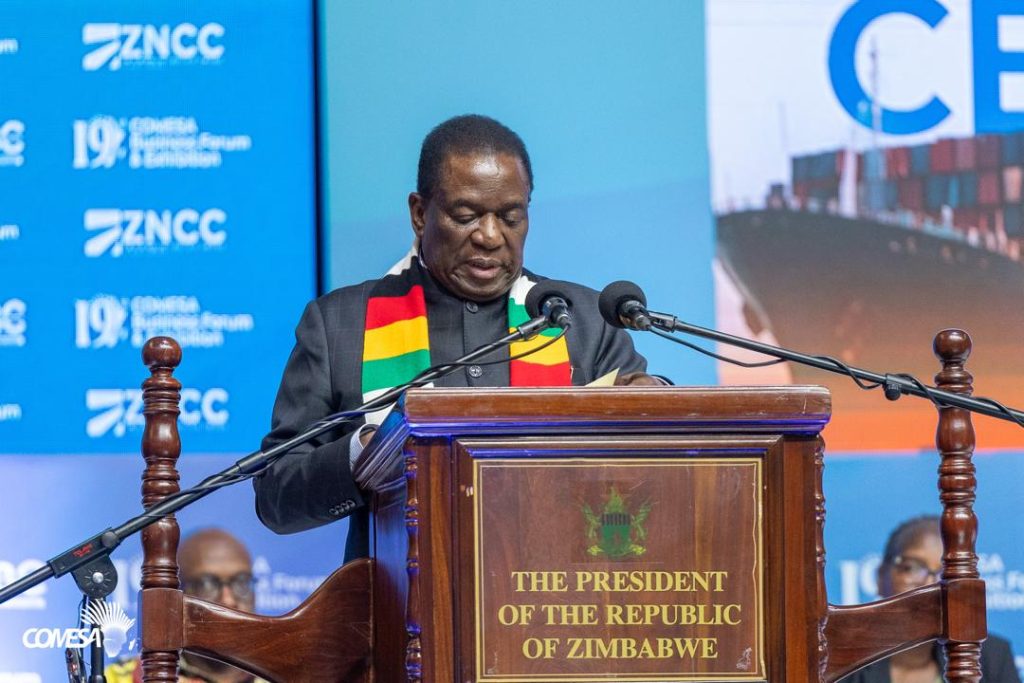
HARARE — President Emmerson Mnangagwa has challenged businesses across the Common Market for Eastern and Southern Africa (COMESA) to ditch raw commodity exports in favour of value addition.
Mnangagwa urged investors to channel capital into manufacturing, mineral beneficiation and cross-border supply chains to unlock the region’s economic potential.
Opening the 19th COMESA Business Forum in Harare on Tuesday, Mnangagwa said the regional bloc needed to turn its market integration ambitions into tangible investments, industrial growth and jobs, with businesses encouraged to produce and process more within the region.
“Private sector players are urged to move decisively from the export of commodities towards value addition, beneficiation and manufacturing.
“On its part, Zimbabwe, in December 2022, made the decision to restrict exports of unprocessed lithium ore, in alignment with our determination to accelerate industrialisation and retain value at source,” he said.
The forum, held under the theme One Market, One Future: Advancing Inclusive Industrialisation, Investment and Regional Integration in COMESA, brings together policymakers, investors, business leaders and development finance institutions ahead of the bloc’s 25th Heads of State and Government Summit.
Mnangagwa said regional integration should go beyond political declarations, with investments designed to connect producers, suppliers and consumers across member states rather than operate as isolated national projects.
“A Zimbabwean agro-processor should be able to source packaging from Zambia, access finance from a regional financial institution, and work with a Kenyan distributor to reach consumers across COMESA.
“For the private sector gathered here, there are diverse prospects presented by regional integration which brings practical expression to the motto ‘One Market, One Future’,” he said.
COMESA comprises 21 member states, offering businesses access to a wider regional market.
However, the bloc continues to face challenges in reducing trade barriers, strengthening infrastructure and expanding the participation of local manufacturers in regional commerce.
The United Nations Conference on Trade and Development’s COMESA Investment Report 2025reported that foreign direct investment inflows into the bloc surged by 154% to a record US$65 billion in 2024, largely driven by Egypt’s Ras El-Hekma mega-project.
Excluding that project, investment inflows would still have increased by 16%, pointing to broader improvements in investor activity across the region.
The figures underline the investment potential available to COMESA economies, although attracting capital into large projects must also translate into stronger local production, employment and regional industrial linkages.
Mnangagwa identified agriculture, critical minerals, energy, manufacturing, pharmaceuticals, tourism and digital technologies as sectors offering opportunities for investors seeking to establish regional value chains.
He urged businesses to explore agro-processing, leather production, cotton-to-clothing manufacturing, battery materials and clean-energy technologies, arguing that the region should capture more value from its natural resources and agricultural output.
The push for industrialisation also dovetails with the African Continental Free Trade Area (AfCFTA), which seeks to create a single continental market for goods and services and encourage investment in regional value chains.
COMESA is expected to play a role in advancing that wider integration agenda.
However, Mnangagwa acknowledged that the ambitions would remain difficult to achieve without addressing the costs and administrative obstacles that hamper cross-border commerce.
“Intra-COMESA trade and investment remain significantly low.
“This gap presents both a challenge, as well as an opportunity,” he said.
He called for practical solutions to disputes over rules of origin, non-tariff barriers, lengthy customs procedures and other costs of doing business, while urging member states to improve transport corridors and digital trade systems.
“Our borders are gateways to markets and not bottlenecks to trade,” Mnangagwa said.
Zimbabwe’s modernisation of Beitbridge Border Post and the upgrading of the Chirundu One-Stop Border Post were cited as examples of efforts to improve regional connectivity.
He also called for wider adoption of electronic certificates of origin, digital payments, electronic single-window systems and modern logistics.
The COMESA Secretariat says the electronic certificate of origin and electronic single-window systems are among the instruments being implemented to simplify trade and reduce the time businesses spend navigating border procedures.
Access to finance remains another hurdle, particularly for micro, small and medium-sized enterprises seeking to enter regional supply chains.
Mnangagwa said the forum’s discussions on de-risking trade and investment and closing the small-business financing gap should help businesses secure capital, expand production and reach new markets.
He also highlighted the need to give women and young entrepreneurs greater opportunities to participate in regional commerce.
The accompanying multi-sectoral international exhibition is expected to provide a platform for businesses to identify buyers, meet potential investors and establish commercial partnerships.
Mnangagwa urged delegates to turn the discussions into bankable projects and lasting business relationships, stressing that the ultimate test of regional integration would be its impact on production, trade and livelihoods.
“May this Business Forum renew our mutual commitment to production, industrialisation, investment, value addition and intra-regional trade, so that our ‘One Market delivers One Future’ for all our peoples, no one and no place must be left behind,” he said.