By Victor Fanuel
CHINHOYI — Vice-President Constantino Chiwenga has invoked the November 2017 military intervention to warn President Emmerson Mnangagwa against repeating the mistakes that led to Robert Mugabe’s ultimate demise.
His warning comes amid intensifying tensions over proposed amendments to the Zanu PF constitution to align it with contentious changes to the national Constitution, which have fuelled a widening dispute over leadership succession within the ruling party.
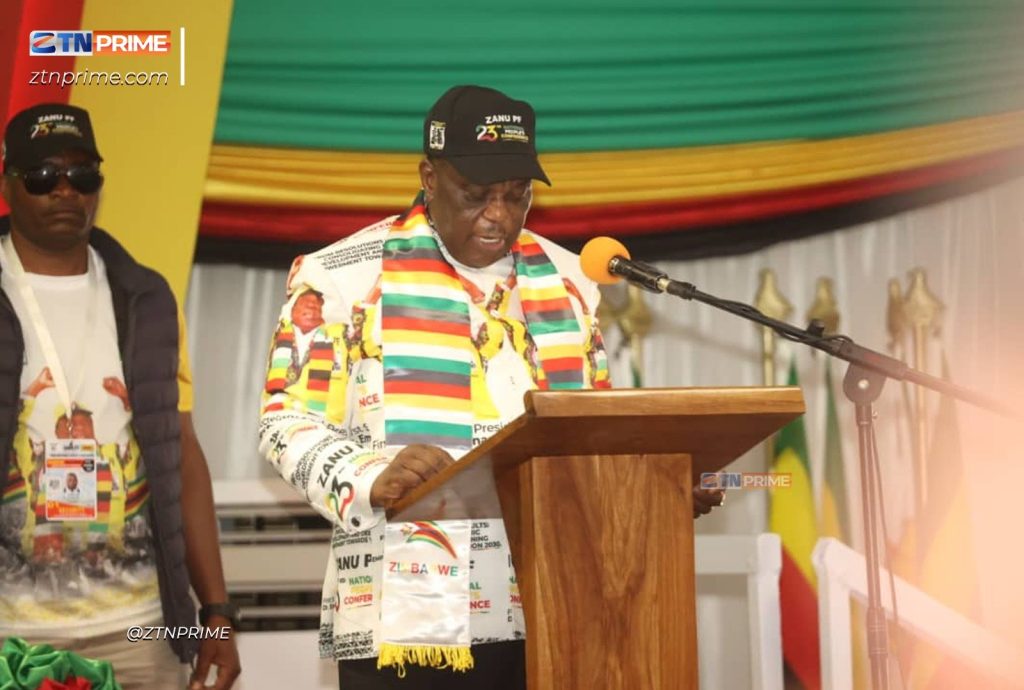
Addressing Zanu PF’s 23rd National People’s Conference in Chinhoyi on Friday, Chiwenga delivered a pointed rebuke to a Second Republic that, he warned, must not become the preserve of individuals and a privileged elite.
“Our party belongs to the people, never to individuals.
We must listen to them attentively, for they are the ones who entrusted us with this mandate.
“We are here to serve the people, never to be served by them,” Chiwenga said.
The remarks carried particular weight coming from Chiwenga, a retired army general who played a central role in the 2017 military intervention that ended Mugabe’s 37-year rule.
Last week, Chiwenga opposed the proposals to amend the Zanu PF constitution at an extraordinary politburo meeting, contributing to the postponement of the indaba under controversial circumstances.
Proposed changes to the Zanu PF constitution could reshape the party’s leadership succession process, extend Mnangagwa’s tenure as party leader beyond 2030 and postpone the party’s elective congress.
Disputes over the draft changes have however, exposed a fault line within the ruling party over whether its internal rules will safeguard collective decision-making or accommodate the political ambitions of the incumbent leadership.
Constitutional Amendment Act No. 3 (CAA3) has become a central point of contention, with efforts to align the Zanu PF constitution with the contentious law intensifying the struggle over succession.
Critics argue that the changes would concentrate power in the presidency at the expense of accountability and internal democracy.
Chiwenga’s warning that the party belongs to the people rather than individuals therefore comes at a politically sensitive moment for Mnangagwa and his allies.
“Change must be driven by the people, not imposed from above.
“The voice of the people is the voice of God,” Chiwenga said, insisting that change must follow party structures and the Zanu PF constitution.
Emerging disputes have also revived comparisons with Mugabe’s removal in November 2017, when the military seized control of key institutions amid a succession crisis involving his wife, Grace Mugabe, and the G40 faction, whose opponents accused its members of seeking to position themselves around the presidency.
Dubbed Operation Restore Legacy by the military, the intervention culminated in Mugabe’s resignation and his removal as Zanu PF leader.
Mugabe resigned after the military intervention and Zanu PF moved to remove him as party leader.
Eight years later, Mnangagwa faces criticism that his own political circle is accumulating wealth and influence while proposed constitutional changes threaten to prolong his stay in office.
Although the circumstances are not identical, the comparison raises concerns about whether the Second Republic is departing from the principles invoked to justify Mugabe’s removal.
Chiwenga made a more explicit accusation against Mnangagwa in September 2025, when he reportedly presented a dossier to the politburo accusing wealthy presidential allies of corruption and warning that the conditions that led to the November 2017 intervention were returning.
“Today, history is repeating itself in the most shameful way Comrade President.
“The so-called 2030 Agenda to extend your term of office is real and alive, and this has now taken us back to the ills that led us to November 2017,” Chiwenga was quoted as saying in a leaked account of the dossier.
The reported allegations marked a significant escalation in the fallout between the two men, who emerged from the 2017 transition as political partners.
Chiwenga accused Mnangagwa’s wealthy allies of using their resources to influence Zanu PF structures and protect their interests.
Businessman Kudakwashe Tagwirei’s rapid ascent through the ruling party and government has since added another dimension to the succession struggle.
In little more than a year, Tagwirei has advanced from Zanu PF Central Committee member to senator, cabinet minister and, on Thursday, secretary for economic affairs and investment promotion in the party’s powerful politburo.
Mnangagwa appointed Tagwirei to the Senate after the constitutional changes provided for 10 additional presidentially appointed senators.
He subsequently named him minister of economic development and investment promotion before elevating him to the politburo.
The sequence has fuelled speculation that Tagwirei, a wealthy businessman with close ties to Mnangagwa, could emerge as a potential successor.
There is, however, no publicly established evidence that Mnangagwa has formally designated him for the role.
Chiwenga did not mention Tagwirei in Friday’s speech.
His warning against a system in which ordinary Zimbabweans depend on the benevolence of a privileged few nevertheless offered a pointed contrast to the growing influence of wealthy figures around the president.
“Our collective resolve to attain Vision 2030 must be to consolidate economic development, uplift the living standards of the people and make them proud citizens of this country, not hewers of wood and drawers of water, surviving on the benevolence of a privileged few,” Chiwenga said.
Chiwenga’s remarks challenged the Second Republic to demonstrate that its promises of economic development and empowerment extend beyond politically connected beneficiaries.
Chiwenga also reminded delegates that leadership was temporary and that those entrusted with the party’s authority would ultimately be judged by their conduct.
“As we deliberate at this momentous conference, we must remember that we are merely temporary custodians of this vanguard party, for our time on Earth is finite.
“So, comrades, we must ask ourselves: What legacy are we leaving?” he said.
Eight years after the military intervention that removed Mugabe, Chiwenga’s warning places the Second Republic’s founding promises under renewed scrutiny as the battle over constitutional changes and succession threatens to reshape the future of Zanu PF.