By Staff Reporter
HARARE — For decades, piles of uncollected refuse became an unfortunate symbol of urban decay in Harare, Zimbabwe’s capital.
Across high-density suburbs, residential areas and even parts of the Central Business District (CBD), overflowing dumpsites, littered streets and delayed refuse collection increasingly defined daily life for residents.
Today, while challenges remain, a visible shift is taking place.
Since assuming a broader role in waste management and refuse collection operations, Geo Pomona Waste Management has emerged as one of the key players behind ongoing efforts to restore cleanliness to Harare, bringing renewed hope to residents who had become accustomed to living alongside accumulating garbage.
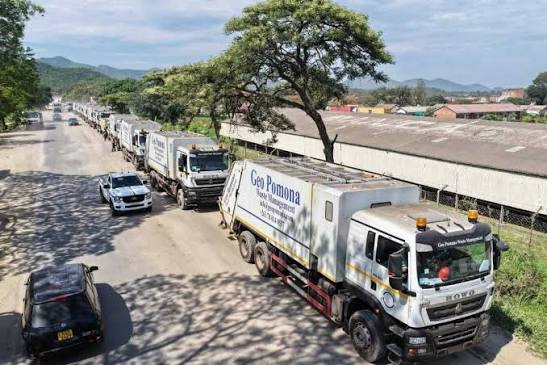
The latest addition of 10 compactor and front-loader trucks to the company’s fleet marks another milestone in a programme that has steadily expanded since 2022, when Geo Pomona took over operations at the Pomona dumpsite under a government-backed waste management project.
The company says the new trucks complement dozens of refuse collection vehicles already deployed across the city.
For many residents, however, the most important measure of success is not the number of trucks acquired but the visible difference on the ground.
A city once buried under waste
Before the expansion of Geo Pomona’s operations, Harare’s waste management system was under immense strain.
Research published in 2022 observed that household solid waste management had stretched beyond the capacity of local authorities, with inadequate collection systems contributing to growing environmental and public health concerns.
In many suburbs, illegal dumpsites became commonplace.
Residents often went weeks without refuse collection, forcing some to burn waste or dump it in open spaces.
The CBD was equally affected.
Visitors and residents frequently complained about litter-strewn streets, overflowing bins and blocked drainage systems.
Social media discussions and community forums regularly highlighted concerns about deteriorating sanitation conditions across the city.
The consequences extended beyond aesthetics.
Public health experts have long warned that uncollected refuse creates breeding grounds for disease-carrying pests, contributes to water pollution and undermines efforts to maintain hygienic urban environments.
The Turning Point
Geo Pomona’s initial intervention focused on clearing illegal dumpsites scattered across Harare before gradually expanding into structured refuse collection services.
The company introduced a phased approach that targeted accumulated waste while building capacity for city-wide collection operations.
By commissioning of dozens of refuse collection trucks significantly altered the scale of operations.
Door-to-door refuse collection programmes were introduced across residential areas and the CBD, covering suburbs including Glen View, Glen Norah, Highfield, Mufakose, Hatcliffe, Mabvuku, Sunningdale, Hatfield and other parts of the capital.
Residents who had become accustomed to irregular municipal services suddenly began seeing refuse trucks on a more predictable basis.
In Mbare, one of Harare’s oldest and most densely populated suburbs, residents described the return of regular waste collection as a major improvement after years of inconsistent service delivery.
Reports from the suburb indicated that refuse heaps that had become permanent features of some neighbourhoods were gradually being removed.
Visible changes across the city
The most noticeable difference has been the reduction of illegal dumpsites in many communities.
Geo Pomona has undertaken numerous clean-up campaigns while simultaneously increasing refuse collection frequency.
The company has also deployed skip bins at markets, bus termini and other high-traffic areas where waste accumulation had become a recurring problem.
In the CBD, where overflowing waste often undermined Harare’s image as the country’s commercial hub, residents and businesses have reported improved waste removal in several key areas.
Geo Pomona’s operations have increasingly focused on locations that generate large volumes of refuse, including markets, shopping centres, bus termini and major transport corridors.
The difference is particularly evident in suburbs that previously relied on sporadic collection schedules.
A number of residents interviewed in various reports noted that regular refuse removal has reduced unpleasant odours, discouraged illegal dumping and improved the overall appearance of their neighbourhoods.
Others pointed to the potential public health benefits associated with cleaner surroundings.
More than trucks
Despite the progress, Geo Pomona chief executive officer and executive chairman Dilesh Nguwaya,believes the next phase of the city’s transformation requires more than infrastructure.
Speaking after receiving the latest fleet of refuse collection vehicles, Nguwaya argued that lasting success depends on changing public attitudes towards waste disposal.
“What we need is behaviour change so that residents know how to manage waste until it gets here to us,” he said.
His remarks reflect a growing recognition that effective waste management requires cooperation between service providers and residents.
Environmental experts have consistently argued that littering, illegal dumping and poor waste handling practices can undermine even the most sophisticated collection systems.
Studies show that sustainable urban sanitation depends not only on collection capacity but also on community participation and responsible waste disposal habits.
The road ahead
Harare’s waste management challenges have not disappeared overnight.
Rapid urbanisation, population growth and decades of infrastructure deficits continue to place pressure on the city’s sanitation systems.
Yet the contrast between the capital’s recent past and its present trajectory is increasingly difficult to ignore.
Where refuse heaps once dominated many street corners, collection trucks are becoming a more common sight.
Areas that had long been associated with illegal dumping are receiving regular attention, while expanded fleet capacity promises greater coverage in both residential and commercial districts.
For a city that once proudly carried the title of the Sunshine City, the improvements represent more than cleaner streets.
They signal a gradual effort to restore civic pride, improve public health and rebuild confidence that basic urban services can work.
Whether Harare ultimately reclaims its former reputation may depend not only on the trucks arriving at Geo Pomona’s depot, but also on the willingness of residents, businesses and authorities to embrace a shared responsibility for keeping the city clean.
For now, however, many residents are seeing something they had not witnessed consistently for years — refuse being collected before it becomes a crisis.